Showing posts with label Humarock. Show all posts

Wednesday, June 15, 2011

Pizza Pies

Research tells me the first American pizzas were known as “tomato pies.” Tomato pies are built the opposite of the “Pizza Pie,” first the cheese, then the toppings, then the sauce.


It wasn't until the 1950s that Americans started to notice pizza. Celebrities of Italian origin such as Jerry Colona, Frank Sinatra, Jimmy Durante, and baseball star Joe DiMaggio all devoured pizza. It is also said that the line from the song by famous singer Dean Martin, “When the moon hits your eye like a big pizza pie, that’s amore,” set America singing and eating pizzas! [1953].


I cannot remember having a pizza during World War II or before. My parents would try many places for a Saturday night pizza. The closest pizzas were the Bridgwaye Inn and the Humarock Lodge, but neither were satisfactory.

Next tries were a place in Fieldston, then Brant Rock, with no luck.

A Greek restaurant in Scituate, nope. Not that these pizzas were bad -- they just were not pleased with some part of the pizza.

Maybe 1947 or 8, my uncle Herb, Dad’s twin, got a nighttime job at the Rockland Bar and Grille in Rockland. Herb alerted my parents to the great pizzas. One Saturday night we drove to Rockland to try one. I think in those days there were only cheese pizzas. It was great!

Whenever my folks wanted a pizza, off to Rockland we went. I can remember after I got my driving license (May 1951), I would be sent to Rockland for a takeout pizza.


In 1949 or 50, a new building was constructed at 20 Sea Street, in Humarock (really Seaview). A family from Quincy, that operated a pizzeria in Quincy, opened Miramare Pizza as a summer business.


There was Sal, the cook; his sister Celeste was the waitress and cook; and the matriarch mother, Naomi, ran the cash register. They would let me stash my bike behind the building when I went to Humarock. This was during the rebuilding of the new Sea Street bridge, during the summer of ' 51 (completed in 1952).

After stashing my bike, I would take my chances crossing the bridge over the catwalks provided for the work crew. They were planks maybe 10” wide and stretched randomly across the spans of the old part -- and some of the new parts of the construction too. We kids from both sides would, at night, go to Humarock or cross back to get to the pizzerias, or to “Stead's.”


Pizzerias, yes. At one time, another pizzeria opened in the Davis bakery across from Miramare's. They may have been Greek pizzas.

Miramare's pizza place had plenty of parking, but the joint across the street did not -- so people would park in Miramare's lot and walk across the street to the Greek place.

Well Naomi would have no part of that. She would yell out the front door to get the hell out of her lot! If they did not respond, Naomi would stomp right up the stairs into the joint and make them move their car or she would call the cops. She would make quite a scene!

Some of my friends liked the Greek pizzas. One time I joined them but didn't purchase any food, only a soda. Well Naomi saw me coming out of the joint and did she give me hell.

I explained I didn't buy anything but a soda. It didn't matter. If you’re going in there, don't come in here!”

Later that night, I went into Miamare's for a pizza with a friend. I got the cold shoulder from the old matriarch.

One cheese pizza: 75 cents. Two drinks: 20 cents. A 15 cent tip. Total: $1.10, split 55 cents each. That was the summer of 1952.


The pizza joint across the street didn't last long -- maybe two summers.

Miramare's stayed into the 60s. It closed soon after Sal died.

Now Papa Gino’s gets our $10-$12! We don't have a Papa's here in “Down East” Maine, so my wife and I put together a pretty good 'roni and 'shroom pizza every Sunday night.

I don't remember 5 cents.
But I do remember a 10 cent  slice.


Ray Freden
Sea View resident 60 years, Marshfield, 70

Monday, February 28, 2011

Prohibition & Rum Running in Humarock


River look-outs, making sure the coast is clear.
If you have read my past story of the SC 41 Submarine Chaser that ended up on the Hanover Flat (and was used as a summer retreat), as well as the one on Leon Hatches Boat Yard, you now could be ready for “rum running” in Humarock.

For nearly 14 years, 1919 to 1933, our country was dry! It really wasn't, but selling alcohol was illegal. It didn't take long for the “swamp Yankees” to turn to “rum running.”

Illegal contraband liquor was a profitable enterprise for the water people. Boat motors were quickly converted over to more powerful and faster ones, and the insides of vessels were gutted for more space. A schoolmate, Alfred A., told me that his stepfather’s lobster boat was a “rum runner.” It had a big motor in it, and was quite narrow for a lobster boat.

Safe unloading areas were located. Bays, harbors, rivers, creeks, and other landing spots were found. Humarock was one of these safe places -- or at least more safe than other harbors. Federal funding was weak and the revenuers had to spread themselves thin.

This was an ideal drop off spot, just off the South River.
The North River mouth was the water highway out to the mother ships that were waiting three miles out to unload their contraband into smaller boats and dories. A very reliable source told me that most of the dories came from Hatch's Boat Yard and gunning stand. Others came from the North River. Most of the dories were powered by two rowers.

On a good night, a row out to the “Mother Ship” and back, took most of the darkened hours, depending on the weather. On occasion, unfavorable weather would delay the boatmen’s return. Daylight would give them away, so they would row up into a remote creek, cover their dory with marsh grass, and hunker down for the day with nothing to eat or drink! Or nothing to eat! Up to 20 cases could be safely stacked in the dories, however greed and poor judgment sent many boats floundering and losing their contraband. Some of this contraband would find its way to shore, where scavengers would find liquid gold!


Lookouts were needed to warn the boatmen of any danger that may come about. Lookout posts were stationed from the Sea Street Bridge to Fourth Cliff.

The lookout on the bridge was a well known local that had a non-drinking reputation, and liked to fish. His gear was a tin bucket, bait, a sharp knife, a hand line, a flashlight and cigarettes. Time on was 9 or 10 pm; off was daylight, rain or not. If the boats were out, you were on. Over would go the line, baited or not. Sometimes this lookout was joined by a friend -- his line would go over with a bottle of hooch tied on the end. This was to be retrieved periodically.

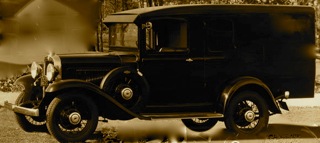
The hooch was unloaded at various locations. The cases were picked up by Chevy 6-cylinder panel trucks. Chevys were quieter than the Ford Model A’s. Canvas snap-on signs were attached to each side with a local milk company logo.

I was told, by the same reliable source, that only once, during this guard’s time on the bridge, did he have to call off a landing.

One night, just before midnight, a big black Packard with four men inside, strangers, stopped on the bridge and asked where so-and-so's cottage was. The fisherman gave them directions, and off they went. The fisherman/guard flashed a signal to the lookout on the point down river, and the signal was passed on to the cliff.

That night’s truck was turned around and left. No one else ever reported seeing the car or the men. No one saw them leave; no one reported using so-and-so’s cottage. However, this was a subject not discussed, and questions were unthinkable.

My late friend Phil, a Seaview native, told me the following. It seems that Charlie, Phil's father, took a walk to Pine Island. While coming back, just off the walkway, he saw a newly tracked path in the marsh grass. Off he went to investigate. He found something that was covered over with marsh grass. A case of 11 bottles of hooch!

Even though Charlie was a teetotaler, he was not going to leave this find. He covered it back up and waited until dark. Charlie made his way back through the cedar grove to the edge of the marsh, found the case of hooch, then made it home without being seen, he hoped! He stashed the case in the cellar, where his wife would not find it, as she was death against alcohol.

Within a few days, word reached Charlie, that Wally, a heavy drinker, was on a killing rage. It seems that someone stole his property from The Island. He was telling everyone in Seaview that if he found out who stole his property, he was going to kill them!

You see, the property was never Wally's. He probably found it stashed in one of the creeks by a boatman. Charlie never uttered a word. Some of Charlie's friends enjoyed a holiday gift!

 Chevrolet panel truck, much like the trucks used to deliver
illegal liquor to the speakeasies.


Ray Freden, Seaview resident, 60 years.

Tuesday, January 4, 2011

Hatches Boat Yard

As a kid from Seaview, I have always been fascinated by Humarock. From as early as I can remember, about 1939, until 1954 when I broke away from my year-around visits, finding other places of interest. However I always have to take a drive up to the Cliff when I'm in the area.

One fall day my Dad piled me into the old Chevy and off to Hatches Boat yard -- I can't remember why. We arrived and Dad parked in front of the shed-like building. We got out and went up a few stairs, through a side door and into the front room. There was a large desk and chair, and some stuff hanging on the wall.

The men and Leon Hatch were in the back room -- but let me describe the building and area.

The area is on the west side of Central Ave, Humarock -- across from Seaview Ave. and the north end of Shore Drive.

The largest building ran with its gables east and west, with large sliding doors on the east side -- they seemed boarded tight, with no ramp or entrance.

The entrance door was on the left side, with maybe 3 steps.

There was a smaller, shed-like building, attached on the left (south side), with two doors. If any boatbuilding was going on, it was in there. There was room to park in front of these doors.

The foundation on the north and west was made of field stones, of which some are still visible today.

Dories were stacked on one another on the south side. On the north side there were tracks that ran from near the street to below the low water line. A cradle with wheels sat on the tracks, and a winch was at the head of the tracks.

There were dories pulled up on the north beach, maybe ten of them. Leon rented out boats to fishermen and hunters.

The building was shingled and silver grey and in poor condition outside. There were two brick chimneys, one in the shed-like building, and one in the west room of the main building.

My Dad and I walked through the front room, knocked, and went into the back room. Oh wow! Four men were sitting around a table, playing cards; a bottle of whiskey sat in the middle. You could hardly see across the room, the cigar and pipe smoke was so thick. The back (west) window was open, so I headed that way.

My Dad was talking to Leon. The others greeted my Dad with a, “Hi Bill.” My Dad worked for Charlie Clark (Clarks Store) from 1927 to 1934, as a clerk and real estate agent, so he was no stranger to the Humarock people.

As I peered out the window, the river was full of ducks and geese! They were acting strange, not moving about as I had seen in Keene's Pond. I asked the man closest to the window about them. He said they were decoys.

“What’s a decoy?” I asked.

He explained they were made of wood, and the ducks thought they were real.

It was coming together now -- guns leaning against the walls, gun shells on the shelf. I was fascinated, I was excited, I wanted to see the ducks come in and land beside the wood ones. No one in our family hunted, so I knew nothing about guns and hunting.

I paid no attention to what my Dad and Leon were talking about. I just kept looking out that window at those decoys. As I turned from the window, I accidentally kicked a gun that was leaning close to the window. It went crashing to the floor. Well all hell broke loose. One man hollered at my Dad to get that G--D--- kid out of here!

Well, I was on the way on my own! Through the door to the front room, out the door, and down the steps into the old Chevy, down on the floor bawling my head off!

Dad was close behind and into the Chevy. Off we left to home. Dad assured me it was an accident and not to worry any longer.

A stop at “Steads,” a bottle of Ballantine Ale and a cigar for Dad, and a candy bar for me. All was well.

The many times that I have passed Hatches, I so remember that day. I never set foot in that building again!

I was recently approached by the current owner of the Hatches Boat Yard property, to see if I knew of any pictures of the building. I do not. However I sketched the building as I remember it.

If anyone has a photo of “Hatches,” he would love a copy.

Wednesday, December 22, 2010

Learning to Drive on Central Ave. in Humarock

It must have been 1940. I was coming up to 6 years old. On Saturdays, late afternoon, Dad would drive his old Chevy to Steads store to get a bottle of Ballantine Ale and a cigar. I would beg him to drive to Fourth Cliff. We would drive over the hump in the old wooden bridge, pass Dick Smith’s garage, and make a left on Central Ave. Stopping near the Humarock Lodge, I would climb into his lap so I could steer and shift.

Dad taught me how to shift the 3-on-the-floor. Dad would operate the clutch and gas; I would steer & shift.

“Okay, into first,” he would say. Away we went.

“Okay, into second.” We went faster!

“Okay, into third'.” We were flying! Maybe 30 miles an hour past Hatches boat yard.

We turned at the base of Fourth Cliff and returned to the Lodge. I would take my place in the passenger side, then urge my Dad to go fast over the hump in the bridge -- which he did. All the wheels flew into the air! Or at least that’s what I thought. No, we didn't tell Mom 'til years later.

During the war years, there were fewer trips to the Cliff because of travel restrictions. Dad worked for the Boston Record American Newspaper and had a news reporter pass, so we were let through the barricade, and no, he wasn't a reporter. Dad did not allow me to drive in Humarock during those times.

After the war, I could drive without sitting in Dad’s lap, so off to Humarock for a drive out to the Cliff, or south Humarock to Carl Moreheart's parking lot next to Rexhame Beach.

Some Memories of Going to Humarock

From a very early age, I remember my Mom pulling my wagon to Humarock from our home in Seaview, to visit with her sister Margie. My Dad attached a box onto the wagon and I fit inside. It was a long bumpy ride. The roads were not paved as smooth as they are today (later in my youth, I was always frustrated trying to roller skate on the rough Seaview streets).

As we came over the knoll on Sea Street, Humarock came into view with the old wooden bridge to cross. During one of these trips across the bridge, my wagon wheel slipped down in between the boards, and my Mom couldn't pull it out. She had me get out and we tugged at it -- to no avail. I was pretty scared and in tears. My Mom took hold of me and across the bridge we went, leaving my wagon behind. She knew where help would be.

Into the Humarock Garage we went, to ask her friend Dick Smith, the owner, for help. He said, “Sure, Ruthie.” He came out with a pry bar and off we went back to the wagon. One pry and out it came. My wagon was saved!

Mr. Smith told my Mom not to use the wagon, with its narrow wheels, on the sidewalk -- to use the roadway instead, because the boards went the other way and so the wheels would not get stuck.

Mr. Smith, Mom, & I in my wagon were now off the sidewalk and on our way to visit with my aunt Marge. I don't remember any of the visit, but I do remember the trip back across the bridge. We now were in the roadway, past the hump, and almost off, when a car came along and the driver hollered at us to get off the roadway and onto the sidewalk! My Mom hollered back at him and told him to go-somewhere! There was quite a bit of talk -- about that person -- at the supper table that night with Mom & Dad. Mom knew who the driver was that hollered at us, but she never told Dad.

Friday, June 4, 2010

WWII Air Raid Patrols & Military Convoys


 There was an air raid horn mounted atop the Seaview Garage roof. It was tested every week at night. My Dad was a warden. The horn would sound and scare the ---- out of me! Dad would don his air raid outfit, a helmet, an armband, a flashlight, dark clothing, a nightstick, a whistle and a notebook. He patrolled from the Seaview Garage to the O'Donnells' at 90 Summer Street.

The wardens were to be responsible for all lights out and no driving of cars. One time a car came down Summer Street during the test and my Dad stopped the driver. He said, "Harry you can't drive. Pull over to the side and wait for the all clear." Harry responded, "Bill, go to Hell," and drove off. Dad never reported him as he should have. Harry apologized later.

When my Dad was on his air raid patrol beat, he would pass our house (189 Summer Street) and give a little flash of his light to the special window, where I'd be sitting, watching and waiting, on the second floor landing. This window had a clear center with different color stained glass around the border. I could see clearly to Central Ave, near the bottom of 4th Cliff during the day.

During the war years, military convoys would come down Summer Street past the Seaview Garage and past my house, sometimes during the day. That’s when I would wait until they passed, then run into the house, up the stairs to my window, and watch them moving slowly up Central Ave. in Humarock. They were going to the Air Force Base on 4th Cliff. At night, it was a different story. When a convoy came through at night, one could barely hear or see them, with no lights on or very small slits on their headlights. After they passed, I would take my Dad's binoculars, go to my window, and try to see them approaching the Cliff -- usually with no luck. I always thought enemy subs or ships were off 4th Cliff, and so reinforcements were sent to the base. It was pretty scary for an 8 or 9 year old!

 Convoy stopped for a break, c.1944.


by Ray Freden
Originally published in the Marshfield Mariner, January 21, 2009