Monday, February 28, 2011

Prohibition & Rum Running in Humarock


River look-outs, making sure the coast is clear.
If you have read my past story of the SC 41 Submarine Chaser that ended up on the Hanover Flat (and was used as a summer retreat), as well as the one on Leon Hatches Boat Yard, you now could be ready for “rum running” in Humarock.

For nearly 14 years, 1919 to 1933, our country was dry! It really wasn't, but selling alcohol was illegal. It didn't take long for the “swamp Yankees” to turn to “rum running.”

Illegal contraband liquor was a profitable enterprise for the water people. Boat motors were quickly converted over to more powerful and faster ones, and the insides of vessels were gutted for more space. A schoolmate, Alfred A., told me that his stepfather’s lobster boat was a “rum runner.” It had a big motor in it, and was quite narrow for a lobster boat.

Safe unloading areas were located. Bays, harbors, rivers, creeks, and other landing spots were found. Humarock was one of these safe places -- or at least more safe than other harbors. Federal funding was weak and the revenuers had to spread themselves thin.

This was an ideal drop off spot, just off the South River.
The North River mouth was the water highway out to the mother ships that were waiting three miles out to unload their contraband into smaller boats and dories. A very reliable source told me that most of the dories came from Hatch's Boat Yard and gunning stand. Others came from the North River. Most of the dories were powered by two rowers.

On a good night, a row out to the “Mother Ship” and back, took most of the darkened hours, depending on the weather. On occasion, unfavorable weather would delay the boatmen’s return. Daylight would give them away, so they would row up into a remote creek, cover their dory with marsh grass, and hunker down for the day with nothing to eat or drink! Or nothing to eat! Up to 20 cases could be safely stacked in the dories, however greed and poor judgment sent many boats floundering and losing their contraband. Some of this contraband would find its way to shore, where scavengers would find liquid gold!


Lookouts were needed to warn the boatmen of any danger that may come about. Lookout posts were stationed from the Sea Street Bridge to Fourth Cliff.

The lookout on the bridge was a well known local that had a non-drinking reputation, and liked to fish. His gear was a tin bucket, bait, a sharp knife, a hand line, a flashlight and cigarettes. Time on was 9 or 10 pm; off was daylight, rain or not. If the boats were out, you were on. Over would go the line, baited or not. Sometimes this lookout was joined by a friend -- his line would go over with a bottle of hooch tied on the end. This was to be retrieved periodically.

The hooch was unloaded at various locations. The cases were picked up by Chevy 6-cylinder panel trucks. Chevys were quieter than the Ford Model A’s. Canvas snap-on signs were attached to each side with a local milk company logo.

I was told, by the same reliable source, that only once, during this guard’s time on the bridge, did he have to call off a landing.

One night, just before midnight, a big black Packard with four men inside, strangers, stopped on the bridge and asked where so-and-so's cottage was. The fisherman gave them directions, and off they went. The fisherman/guard flashed a signal to the lookout on the point down river, and the signal was passed on to the cliff.

That night’s truck was turned around and left. No one else ever reported seeing the car or the men. No one saw them leave; no one reported using so-and-so’s cottage. However, this was a subject not discussed, and questions were unthinkable.

My late friend Phil, a Seaview native, told me the following. It seems that Charlie, Phil's father, took a walk to Pine Island. While coming back, just off the walkway, he saw a newly tracked path in the marsh grass. Off he went to investigate. He found something that was covered over with marsh grass. A case of 11 bottles of hooch!

Even though Charlie was a teetotaler, he was not going to leave this find. He covered it back up and waited until dark. Charlie made his way back through the cedar grove to the edge of the marsh, found the case of hooch, then made it home without being seen, he hoped! He stashed the case in the cellar, where his wife would not find it, as she was death against alcohol.

Within a few days, word reached Charlie, that Wally, a heavy drinker, was on a killing rage. It seems that someone stole his property from The Island. He was telling everyone in Seaview that if he found out who stole his property, he was going to kill them!

You see, the property was never Wally's. He probably found it stashed in one of the creeks by a boatman. Charlie never uttered a word. Some of Charlie's friends enjoyed a holiday gift!
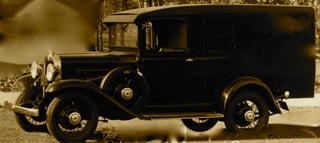
 Chevrolet panel truck, much like the trucks used to deliver
illegal liquor to the speakeasies.


Ray Freden, Seaview resident, 60 years.

Monday, February 21, 2011

A Seaview Kid Goes Shopping

In the 40s, Marshfield did not offer much but basic shopping. The A&P, First National, Wherrity's drug store and soda fountain, Feinberg's clothing store, a general store here and there.

There were traveling vendors -- Hathaway's Bakery Bread, a black and white Chevy panel truck, Smitty was the breadman. There were drawers that would roll out to get the donuts and pastries. The White Brothers milk truck would stop at our house. Herby delivered the milk bottles with the bulb in the top where the cream would settle, a cardboard disc pressed into the top. There was a meat vendor and a fish vendor but I can't remember them by name.

A short drive to Scituate gave my folks much more to choose from. A much larger A&P, an Italian delicatessen. My Mom would buy a wedge of parmesan cheese that would be shredded on our pasta dinner. A 5&10 that I couldn't get enough of. Welch's Hardware Store, where my Dad always had to get something. My Dad & I would get our hair cut at Larry's Barber Shop. We would stop at the Quincy Gas Station at the beginning of Front Street to get a dollar’s worth of gas -- I think gas was under 15 cents a gallon -- that would take the old Chevy and Dad to the Greenbush Train Station all week.

Other shopping trips would be to Rockland, Brockton or Quincy. The Rockland trips were to the Thom McAn shoe store and to Woolworth’s 5&10 cent store, to buy baby chickens. Yes, chickens -- the baby chicks would be in a long high box on the counter with lightbulbs hanging down to keep the chicks warm. Dad would have to lift me up to pick out the most lively ones. I remember some were dyed pink. There was no way to tell which were hens or roosters. Dad always wanted 6 to 8 hens and 4 roosters. The roosters were for the holidays. Many times we got more roosters than hens, so therefore, more holidays.

Brockton was a favorite city for my folks to shop. Both parents were born and brought up there. Sears and Roebuck was the first stop. To park in the rear, you would drive through an opening between two buildings with a large structure above, a rather unusual entrance that intrigued me. This store always had plenty of bikes for me to drool over.

After my folks finished shopping, there was always a stop at the Swedish Bakery on the corner. I will never forget the smell of the freshly baked goods. My Mom would have to buy two loaves of Swedish rye, one for the ride home and one for home. Also a package of knackebrod, a Swedish crisp bread. It came in a paper package glued up on the bottom, so we always opened it from the bottom. Out came a thin, round, greyish brown, cracker-like bread with a hole in the center. It could be broken into pieces easily. I have not seen this round version for years. Now it’s Wasabrod -- Wasa crisp bread -- now cut rectangular. How dull. My Dad said the hole in the middle was to hang it on a pole in the old bakeries. You could buy as many pieces as you wished and the baker would wrap it with brown paper off a large roll, then he would tie it with string. The last Swedish bakery I remember was in Hanover. I do miss that smell and tearing that round loaf of rye open, and eating it dry-raw.

by Ray Freden
Marshfield resident 70 years, Seaview resident 60 years.

Tuesday, January 4, 2011

Hatches Boat Yard

As a kid from Seaview, I have always been fascinated by Humarock. From as early as I can remember, about 1939, until 1954 when I broke away from my year-around visits, finding other places of interest. However I always have to take a drive up to the Cliff when I'm in the area.

One fall day my Dad piled me into the old Chevy and off to Hatches Boat yard -- I can't remember why. We arrived and Dad parked in front of the shed-like building. We got out and went up a few stairs, through a side door and into the front room. There was a large desk and chair, and some stuff hanging on the wall.

The men and Leon Hatch were in the back room -- but let me describe the building and area.

The area is on the west side of Central Ave, Humarock -- across from Seaview Ave. and the north end of Shore Drive.

The largest building ran with its gables east and west, with large sliding doors on the east side -- they seemed boarded tight, with no ramp or entrance.

The entrance door was on the left side, with maybe 3 steps.

There was a smaller, shed-like building, attached on the left (south side), with two doors. If any boatbuilding was going on, it was in there. There was room to park in front of these doors.

The foundation on the north and west was made of field stones, of which some are still visible today.

Dories were stacked on one another on the south side. On the north side there were tracks that ran from near the street to below the low water line. A cradle with wheels sat on the tracks, and a winch was at the head of the tracks.

There were dories pulled up on the north beach, maybe ten of them. Leon rented out boats to fishermen and hunters.

The building was shingled and silver grey and in poor condition outside. There were two brick chimneys, one in the shed-like building, and one in the west room of the main building.

My Dad and I walked through the front room, knocked, and went into the back room. Oh wow! Four men were sitting around a table, playing cards; a bottle of whiskey sat in the middle. You could hardly see across the room, the cigar and pipe smoke was so thick. The back (west) window was open, so I headed that way.

My Dad was talking to Leon. The others greeted my Dad with a, “Hi Bill.” My Dad worked for Charlie Clark (Clarks Store) from 1927 to 1934, as a clerk and real estate agent, so he was no stranger to the Humarock people.

As I peered out the window, the river was full of ducks and geese! They were acting strange, not moving about as I had seen in Keene's Pond. I asked the man closest to the window about them. He said they were decoys.

“What’s a decoy?” I asked.

He explained they were made of wood, and the ducks thought they were real.

It was coming together now -- guns leaning against the walls, gun shells on the shelf. I was fascinated, I was excited, I wanted to see the ducks come in and land beside the wood ones. No one in our family hunted, so I knew nothing about guns and hunting.

I paid no attention to what my Dad and Leon were talking about. I just kept looking out that window at those decoys. As I turned from the window, I accidentally kicked a gun that was leaning close to the window. It went crashing to the floor. Well all hell broke loose. One man hollered at my Dad to get that G--D--- kid out of here!

Well, I was on the way on my own! Through the door to the front room, out the door, and down the steps into the old Chevy, down on the floor bawling my head off!

Dad was close behind and into the Chevy. Off we left to home. Dad assured me it was an accident and not to worry any longer.

A stop at “Steads,” a bottle of Ballantine Ale and a cigar for Dad, and a candy bar for me. All was well.

The many times that I have passed Hatches, I so remember that day. I never set foot in that building again!

I was recently approached by the current owner of the Hatches Boat Yard property, to see if I knew of any pictures of the building. I do not. However I sketched the building as I remember it.

If anyone has a photo of “Hatches,” he would love a copy.

Wednesday, December 22, 2010

Learning to Drive on Central Ave. in Humarock

It must have been 1940. I was coming up to 6 years old. On Saturdays, late afternoon, Dad would drive his old Chevy to Steads store to get a bottle of Ballantine Ale and a cigar. I would beg him to drive to Fourth Cliff. We would drive over the hump in the old wooden bridge, pass Dick Smith’s garage, and make a left on Central Ave. Stopping near the Humarock Lodge, I would climb into his lap so I could steer and shift.

Dad taught me how to shift the 3-on-the-floor. Dad would operate the clutch and gas; I would steer & shift.

“Okay, into first,” he would say. Away we went.

“Okay, into second.” We went faster!

“Okay, into third'.” We were flying! Maybe 30 miles an hour past Hatches boat yard.

We turned at the base of Fourth Cliff and returned to the Lodge. I would take my place in the passenger side, then urge my Dad to go fast over the hump in the bridge -- which he did. All the wheels flew into the air! Or at least that’s what I thought. No, we didn't tell Mom 'til years later.

During the war years, there were fewer trips to the Cliff because of travel restrictions. Dad worked for the Boston Record American Newspaper and had a news reporter pass, so we were let through the barricade, and no, he wasn't a reporter. Dad did not allow me to drive in Humarock during those times.

After the war, I could drive without sitting in Dad’s lap, so off to Humarock for a drive out to the Cliff, or south Humarock to Carl Moreheart's parking lot next to Rexhame Beach.

Some Memories of Going to Humarock

From a very early age, I remember my Mom pulling my wagon to Humarock from our home in Seaview, to visit with her sister Margie. My Dad attached a box onto the wagon and I fit inside. It was a long bumpy ride. The roads were not paved as smooth as they are today (later in my youth, I was always frustrated trying to roller skate on the rough Seaview streets).

As we came over the knoll on Sea Street, Humarock came into view with the old wooden bridge to cross. During one of these trips across the bridge, my wagon wheel slipped down in between the boards, and my Mom couldn't pull it out. She had me get out and we tugged at it -- to no avail. I was pretty scared and in tears. My Mom took hold of me and across the bridge we went, leaving my wagon behind. She knew where help would be.

Into the Humarock Garage we went, to ask her friend Dick Smith, the owner, for help. He said, “Sure, Ruthie.” He came out with a pry bar and off we went back to the wagon. One pry and out it came. My wagon was saved!

Mr. Smith told my Mom not to use the wagon, with its narrow wheels, on the sidewalk -- to use the roadway instead, because the boards went the other way and so the wheels would not get stuck.

Mr. Smith, Mom, & I in my wagon were now off the sidewalk and on our way to visit with my aunt Marge. I don't remember any of the visit, but I do remember the trip back across the bridge. We now were in the roadway, past the hump, and almost off, when a car came along and the driver hollered at us to get off the roadway and onto the sidewalk! My Mom hollered back at him and told him to go-somewhere! There was quite a bit of talk -- about that person -- at the supper table that night with Mom & Dad. Mom knew who the driver was that hollered at us, but she never told Dad.

Wednesday, September 8, 2010

WWII Radar Station on Holly Hill

During World War II, probably in 1943, the Corps of Engineers and private contractors built a radar station on Holly Hill between Buttonwood and Holly Roads, 150 feet above sea level. It was called 112-A, site 1A. The SCR 296A was a standard World War II fire control radar utilized by the U.S. Coast Artillery for engaging surface targets. The function of the radar was, during periods of poor visibility, to provide the range and azimuth of the target vessel to the plotting room of the battery. The six inch battery, #204, was located on Fourth Cliff.

Communication was by underground cable. The cable extended down Holly Road to Elm Street, over Ferry Hill, under Ireland Road, to the South River; then under the river to Central Ave. and on up to the Gun Battery. The cable was about 2.5 inches in diameter, containing a number of copper wires wrapped with insulation and steel covering.

My friend Tom once dug up some of the cable in his front yard on Dwight Road. I witnessed a large portion of it dug up under Ireland Road when the town was doing a drainage project. I’m sure plenty more is waiting to be discovered.

The land for the tower was leased from Ernest Dragon of Upland Road and Laura Dwight, possibly of the Doctor Dwight family that lived in a huge mansion at the end of what is now Christmas Tree Lane.

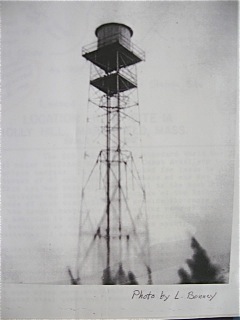
On the site was a concrete building that housed a 2 kw gas generator, and another building that housed a standby generator. A 1000-gallon gasoline tank serviced the generator. A freestanding 114-foot tower that housed the radar antenna was disguised as a water tower. This was located next to a 21'x21' cement block radar transmitter building. A chain link fence with barbed wire on top surrounded the operation.

The SCR 296-A was declared obsolete in January 1946. The tower and equipment were to be disposed of, the buildings to be retained. The barbed wire didn't prevent two young teens from scaling the fence and climbing the ladder to the top of the tower. The view was spectacular!

Radar on Holly Hill, disguised as a water tower. 
Photo taken by Larry Bonney. 

Wednesday, July 7, 2010

SC 241 - The Mysterious Wreck in the Hanover Flats


As long as I can remember, I was mystified by the boat or ship atop the marsh in ''The Hanover Flats,'' between Hen Island and the foot of Fourth Cliff. Sometimes during the summer, at night, my Dad, Mom and I would take a ride to Humarock and up to the cliff. As we passed Hatch’s Boat Yard, the dim shadow of the boat would appear out atop of the marsh, with lights showing thru the windows.

My Dad said it was once a rumrunner -- oh wow, more mystery! Dad told me it was there before he arrived in 1927. Dad worked for Charlie Clark of Clark’s Store in the early '30s and said that the people who lived in the boathouse on the flats would come to the store for groceries during the summer -- but he didn't know their names or where they came from.

During the summer, two or three dories or skiffs would be tied to the rear porch built on the back (stern) of the boat. A large square box-like structure was built in the middle, like living quarters. A line of windows could be seen from Central Ave. There was a tall flagpole near the center. I remember it as being grey natural wood with little paint.

A few of the Humarock kids that had boats would go aboard in the fall or spring, when no one was there, and tell stories about the skeletons seen inside. Not true, but it made even a greater mystery! Oh, how I wanted to go aboard and see for myself. I never did.

There have always seemed to be conflicting stories about the history of the mysterious wreck on the Hanover Flats in the South River, between Humarock and Branch Creek, which is south of Trouants Island. In Edward Rowe Snow’s story about the Submarine Chaser S-241, published in the Patriot Ledger on 12/11/67, he wrote, “First I was informed that the craft was a rum runner which was trapped during prohibition days under heavy gunfire at half tide on Hanover Flats, after which it was abandoned.” I really like that part -- my Dad told me many stories of the rum running days in Humarock.

Snow goes on, “Then I was told it was not a rum runner but a rum chaser which, after a successful career, ended her days on the edge of the North River and went ashore at the Hanover Flats in a gale. This story was objected to by a prominent resident of the area who told me that it was neither a rum runner nor a rum chaser but actually a submarine chaser which had been converted into a rum runner during prohibition and operated in the Marshfield-Scituate area for three years, during which time its owner buried hundreds of cases of liquor at various places on the marsh, two of which I was taken to. Surely enough, it did appear as though something had been placed there at some time.''

Snow continues, “My informant also assured me that there were still scores of bottles which had been hastily pushed into the soft ooze in the area and were still there. As to whether the contents were useable, he did not offer any comment.''

These are the same stories I heard from Seaview and Humarock residents in the '40s. I will have more about buried “hooch” later. Many times I passed the remains of the mysterious wreck to go clamming in the area. The ribs stuck up maybe three feet with some planking still attached. One shaft lay in the middle for years. Not until 1967 did I learn the much more accurate story about the SC 241 from the Edward Rowe Snow article.

A total of 447 SCs were built. The New York Launch and Engine Company at Morris Heights, New York built the SC 241 in 1918. Commissioned April 8 1918, and captained by Ensign Robert L. Mills, she was 110 feet long, beam 14'9'', and draft 5'8'. Her speed was 18 kns, powered by 3three 660 hp gasoline engines, with three props, endurance 1000 nm. Her armament included a 3'' gun, two 30 cal. machine guns and one Y gun.

The origin of the Submarine Chaser (SC) traces back to World War I and the SC-1 class, wooden hulled, “Splinter Fleet.” The SC was designed for off shore patrols and anti-submarine warfare.

The SC 241 left New London, Connecticut, on May 13,1918, after being outfitted with submarine detectors and wireless telephones. She arrived in Halifax, Nova Scotia, five days later. On July 11, 1918, in the company of SC 247, she sighted a U-boat on her starboard side in a thick fog. At 3:40 p.m., she sighted a torpedo heading for a freight ship, which managed to avoid the torpedo. Pursuing the U-boat, she was able to get less than 35 yards away and then fired depth charges from the “Y” gun. One charge landed 10 yards in front of the periscope, which immediately disappeared. Five seconds later, a terrific explosion followed.
It is not known whether the U-boat she destroyed was ever identified.

After the war, the SC 241 was struck from the naval registry. She was sold for scrap on May 11, 1921, to the C.P. Comerford Co. of Lowell, Massachusetts, and stripped of guns, engines and all hardware. Sometime later she was sold to a John F. Smith, and towed by a tug to the South River, where she was then anchored. The Smith family painted the interior in various colors. The SC 241 came with a pilot house and a crow’s nest.

A storm in November 1925 caused the SC 241 to break away from her mooring. Blown across the marsh, she became stranded on the Hanover Flats. The Smith family dug a trench in the marsh and settled the sub-chaser into the south side of the flats. The family added a five-room structure, a rear porch, and a landing on the stern, which faced south. The family used the SC 241 as a summer home for many years.

During World War II, the history-making SC 241 was used less, and without care, began to deteriorate. Torched by vandals, she burned to the water line as fire companies watched helplessly from Central Ave. in Humarock. I never heard that anyone was charged with the arson.

Note: Much of this information came from Edward Rowe Snows “Sea and Shore Gleanings, “ published in The Patriot Ledger on 12/11/67. The coordinates are 42* 09' 10. 88'' N x 70* 42' 21. 81'' W. These are very close to the site were the SC 241 once was.